The renewal that looked steady
You renewed a grant this year at last year's number. It was the responsible move. No drama, no reduction, a signal to the organization that you are still standing behind the work. And in the arithmetic that governs what that organization can actually do, you reduced the gift. Nothing changed on your side. Everything changed on theirs.
This is the second half of a problem we wrote about in June, when we argued that a giving portfolio spread across causes and continents can still run through the same few miles of water. That piece was about hidden correlation. This one is about what the bill looked like once it arrived.
What a dollar buys after six months of a closed strait
Global goods trade reached about $13.7 trillion in the first half of 2026, up 12.5% over the same period last year. Read quickly, that is a healthy number. Read properly, it is the problem. UNCTAD's own reading is that much of the rise reflects prices rather than volume, with trade prices accelerating from 3.6% year on year in the first quarter to 5.1% in the second. The world is not moving more. It is paying more.
The Strait of Hormuz is most of the reason. The disruption has now run roughly 160 days, and on 7 August the channel carried seven ships, about 11.7% of its pre-crisis traffic. Everything downstream of that moved. Urea, the workhorse nitrogen fertilizer, went from about $400 a metric ton to over $850 in April before settling near $453 in June, well above where it started. Container rates from East Asia to the North American east coast went from $4,300 in May to $9,100 in July.
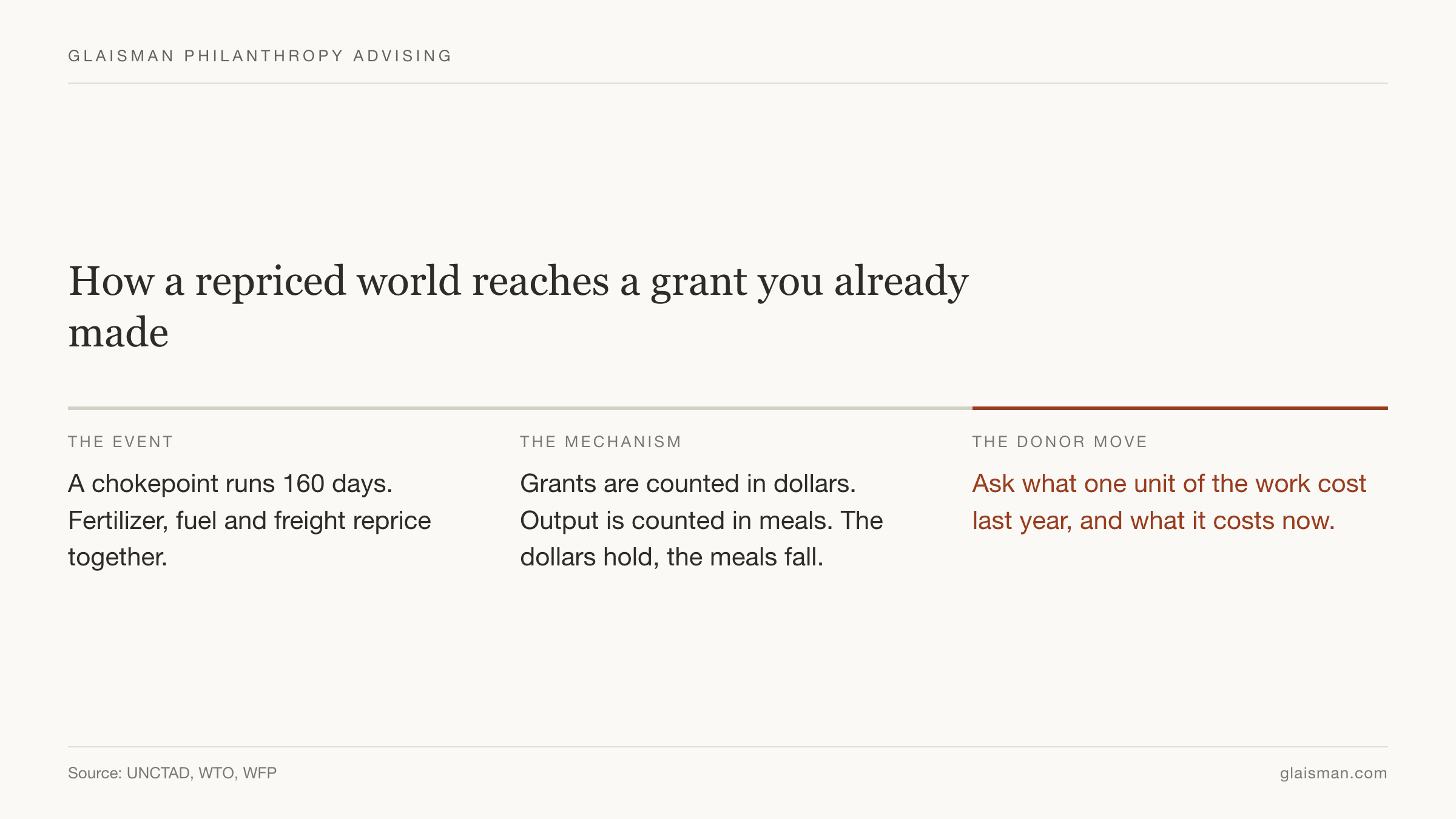
Now put a grant against that. A food program's budget is denominated in dollars. Its output is denominated in meals. When fertilizer, fuel, and freight all move together, the dollars hold and the meals fall. The World Food Programme is carrying exactly this arithmetic at scale, working to reach 110 million people against 318 million at crisis levels of hunger, on roughly half of the $13 billion it says the year requires.
Why the erosion never surfaces
The reason this is invisible is that no one in the transaction is measuring the thing that moved.
You track what you gave, and it is unchanged. The organization reports what it delivered, and it protects that figure, because the grant report asks for people served and not cost per person served. So the number in the report holds. What gives way is somewhere else, and it gives way quietly: a route dropped, a distribution thinned, a vacancy left open, a reserve leaned on. By the time it is visible in an annual report, it has been true for four quarters.
The question that replaces the renewal
Before the next renewal, ask the organization what one unit of its work cost last year and what it costs now. A meal, a bed-night, a clinic visit, a case managed. Any capable finance lead can answer within a minute, and the ones who cannot have just told you something too.
Then ask what a flat renewal means against that number. Not whether they are grateful, which they will be. What it means operationally. The answer is a percentage, and it is the real size of your gift.
The fix is not always more money. Often it is the same money held loosely: unrestricted, so it can move toward whichever input spiked this quarter, and committed across more than one year, so the organization can buy ahead of a price rather than behind it. A gift that holds its number while the world reprices underneath it is not a steady gift, and the only way to know what yours is actually worth now is to ask what it buys.
This issue first appeared in The Informed Funder, the written briefing of Glaisman Philanthropy Advising. New issues every week.